Nilay Serap Umut,Zafer Özyıldız,Melike Altıntaş Korkmaz

  •  Year : 2026
  •  Vol : 3
  •  Issue : 1
  •  Page : 22-33
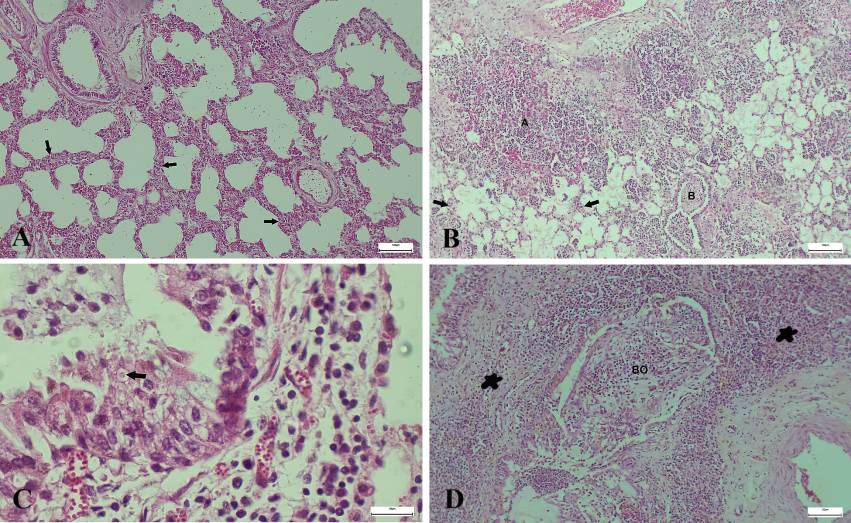
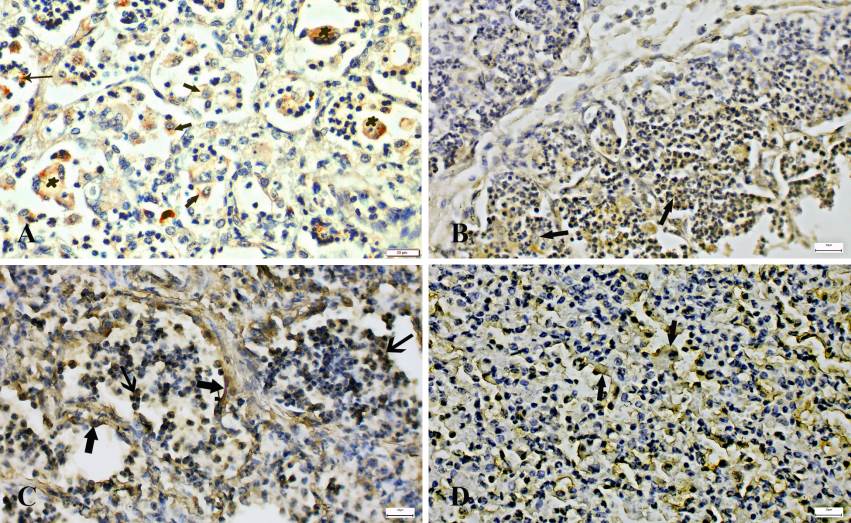
Parainfluenza 3 (PI3) infection is one of the most common viral infections among respiratory system diseases in domestic and wild ruminants. The disease is more frequently observed under poor management conditions, during transportation, and in the presence of concurrent viral and bacterial infections. The most common finding in the disease is characteristic bronchointerstitial pneumonia. Concurrent viral and bacterial infections may exacerbate this condition, leading to fibrinopurulent-necrotic bronchopneumonia. This study aimed to investigate the histopathological findings of PI3 infection in ruminants, the release of Mannose Binding Lectin (MBL) and Surfactant Protein B (SP-B) in lung tissue during inflammation, their roles and importance in pathogenesis, and their interrelationships. For this purpose, paraffin-embedded lung tissue blocks from 30 ruminants suspected of viral pneumonia and 10 ruminants without lesions were used. The blocks were sectioned at a thickness of 5 micrometers and placed on normal and Poly-L-Lysine slides. The normal slides were stained using the Hematoxylin and Eosin staining method. The Poly-L-Lysine slides were subjected to the Avidin-Biotin Complex Peroxidase method. All sections were examined under a light microscope and microphotographs were taken. Histopathologically, the acute destructive phase was observed in most cases (78%), while the chronic proliferative phase was observed in 4 cases (22%). Immunohistochemical methods revealed anti-PI3 positive findings in 15 animals (50%). Additionally, it was determined that MBL release was high in acute cases but decreased in subacute or chronic cases. SP-B release, on the other hand, was higher in subacute and chronic cases compared to acute cases. In conclusion, it was suggested that MBL release might be insufficient for recovery in cases of immunodeficiency or mixed infections, whereas early and accurate treatment could increase the chances of survival through the effects of SP-B.
Conflict of interest : The authors declare that they have no conflict of interest.

This article is published under the CC BY-NC 4.0 license.
Repvas
2026, Vol3, Issue1
E-ISSN: 3023-6681
Received : , Accepted : , Published Online :

References

  1. Alpay G, Tuncer P, Yeşilbağ K (2014). Bir ada ekosistemindeki sığır, koyun ve keçilerde bazı viral enfeksiyonların serolojik olarak araştırılması. Ankara Üniv Vet Fak Derg, 61, 43–48.
  2. Ataseven VS, Başaran Z, Yılmaz V, Dağalp SB (2010). Van bölgesi keçilerinde parainfluenza virus-3 (PIV-3) ve bovine herpesvirus-1 (BHV-1) enfeksiyonlarının seroprevalansı. Van Vet J, 21(1), 7-9.
  3. Avcı O, Yavru S, Ekik M (2014). Detection of respiratory viral antigens in cattle lung tissues by direct ELISA. Animal and Veterinary Sciences,2(5), 146-149.
  4. Ceribaşı AO, Ozkaraca M, Ceribası S, Ozer H (2014). Histopathologic, immunoperoxidase and immunofluorescent examinations on natural cattle pneumonia originated from Parainfluenza type 3, Respiratory Syncytial virus, Adenovirus type 3 and Herpesvirus type 1. Rev Med Vet, 165, 201-212
  5. Dawson PS, Stuart P, Darbyshie JH, Parker WH, McCrea CT (1996). Respiratory disease in a group of intensively reared calves. Vet Rec, 78(16), 543-546.
  6. Degn SE, Thiel S, Jensenius JC (2007). New perspectives on mannan-binding lectinmediated complement activation. Immunobiology, 212(4-5), 301-311.
  7. Eddie Ip WK, Takahashi K, Alan Ezekowitz R, Stuart LM (2009). Mannose‐ binding lectin and innate immunity. Immunol. Rev., 230(1), 9-21.
  8. Erken E (2013). Mannoz Bağlayıcı Lektin Eksikliği ve Klinik Bulgular. Arch. Med. Res., 22(4), 565-574.
  9. Fenner F, Bachmann PA, Gibbs EPJ, Murphy FA, Studdert MJ, White DO (1987). Parainfluenza 3 Infections. In: Veterinary Virology, London: Academic pres, p: 492
  10. Friton GM, Cajal C, Ramirez-Romero R (2005). Longterm effects of meloxicam in the treatment of respiratory disease in fattening cattle. Vet Rec, 156, 809–811.
  11. Garcia-Laorden MI, Sole-Violan J, de Castro FR, Aspa J, Briones ML, GarciaSaavedra A, Olga Rajas, Jose Blanquer, Araceli Caballero-Hidalgo, J Alberto Marcos-Ramos, Hernandez-Lopez J, Rodriguez-Gallego C, Rodriguez-Gallego C 47 (2008). Mannose-binding lectin and mannose-binding lectin–associated serine protease 2 in susceptibility, severity, and outcome of pneumonia in adults. J. Allergy Clin. Immunol., 122(2), 368-374.
  12. Görkem A, Uğur AR, Feyzioğlu B, Ozdemir M, Baykan M. (2020). Çocuk Hastalarda Parainfluenza Nedenli Alt Solunum Yolu İnfeksiyonlarının Araştırılması. Selcuk Med J., 36(2): 87-90.
  13. Gunn HM and Wilson B (1991). Observations on outbreaks of respiratory disease in intersively housed feedlot cattle and climatic considerations. Ir. Vet. J., 44, 41-42
  14. Güneşaçar R, Taştemir D, Yıldırım A, Eryılmaz N (2011). Mannoz Bağlayıcı Lektinin Yapısı, Fonksiyonu, Moleküler Genetiği, Hastalık İlişkisi ve Terapötik Potansiyeli/Structure, Function, Molecular Genetics, Disease Associations and Therapeutic Potential of Mannose Binding Lectin. Turkiye Klinikleri J Med Sci., 31(5), 1250.
  15. Hazıroğlu R, Milli ÜH (1998). Veteriner Patoloji.2. Baskı, Ankara: Tamer Matbaacılık, s:1-130.
  16. Jack DL, Klein NJ, Turner MW (2001). Mannose-binding lectin: Targeting the microbial world for complement attack and opsonophagocytosis. Immunol. Rev., 180, 86-99.
  17. Jim GK, Booker CW, Ribble CS, Guichon PT, Thorlakson BE (1993). Afield Investigation of the Economic İmpact of Respiratory Disease in Feedlot Calves. Can Vet J, 34(11), 668-673.
  18. Mu L, Yin X, Yang Y, Wu L, Wu H, Li B, Ye J (2019). Functional characterization of a mannose-binding lectin (MBL) from Nile tilapia (Oreochromis niloticus) in non- 51 specific cell immunity and apoptosis in monocytes/macrophages. Fish Shellfish Immunol., 87, 265-274.
  19. Mulugeta S, Beers MF (2006). Surfactant protein C: its unique properties and emerging immunomodulatory role in the lung. Microbes Infect., 8(8), 2317-2323.
  20. Ozyıldız Z, Ozmen O, Dolu H (2017). Buzağılarda Respiratuar Sinsityal Virus (BRSV) Enfeksiyonlarında Patolojik ve İmmunohistokimyasal İncelemeler. MAE Vet Fak Derg, 2(2), 131-138.
  21. Ozyıldız Z, Dinçel GÇ, Terzi OS, Ozsoy ŞY, Kul O. (2018). Immunohistochemical investigation of the damage to and repair of myelin, and astrocyte activity in small ruminants resulting from with natural meningoencephalitic listeriosis. Ankara Üniversitesi Veteriner Fakültesi Dergisi, 65(3), 283-290.
  22. R Core Team (2024). R: A Language and environment for statistical computing. (Version 4.4) [Computer software]. Retrieved from https://cran.r-project.org. (R packages retrieved from CRAN snapshot 2024-08-07).
  23. Selvi MH (2024). The use of statistics in veterinary sciences and the test methods used. Research and Practice in Veterinary and Animal Science. Repvas, 1(1), 43-50. https://doi.org/10.69990/repvas.2024.1.1.6.
  24. Sumen SG, Sener Comert S, Caglayan B. (2023). How Can Hyperbaric Oxygen Therapy Affect The Diaphragm and Respiratory Functions of The Patients? Selcuk Med J.,39(3): 97-103.
  25. The jamovi project (2024). jamovi. (Version 2.6) [Computer Software]. Retrieved from https://www.jamovi.org.
  26. Whitsett JA, Weaver TE (2002). Akciğer fonksiyonu ve hastalığında hidrofobik yüzey aktif madde proteinleri. NEJM, 347(26), 2141-2148.
  27. Worthley DL, Bardy PG, Mullighan CG (2005). Mannose‐binding lectin: biology and clinical implications. Intern. Med. J., 35(9), 548-555.
  28. Yüzbaşıgil AF (2010). Kuzu pnömonilerinde patolojik ve bakteriyolojik incelemeler ile parainfluenza 3 (PI-3) virusunun etiyolojideki rolü. Doctoral dissertation, Selçuk Üniversitesi, Sağlık Bilimleri Enstitüsü, Konya/Türkiye.
  29. Yavru S, Şimşek A, Yapkıç O, Kale M (2005). Serological evaluation of viral infections in bovine respiratory tract. Acta Vet-Beograd, 55, 219–226.
  30. Yeşilbağ K, Güngör B (2008). Seroprevalence of bovine respiratory viruses in NorthWestern Turkey. Trop. Anim. Health Prod., 40, 55-60.